

Skills-based hiring hub
You'll find everything you need to know about skills-based hiring, plus a range of useful blogs and resources, right here in our hub.

What is skills-based hiring?
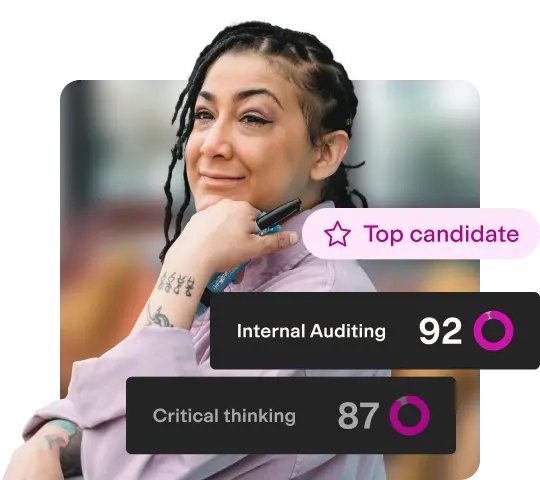
Skills-based hiring is a recruitment approach that evaluates candidates on their demonstrated abilities and job-relevant skills rather than on credentials such as degrees or job titles.
Instead of using a resume as a proxy for capability, employers use structured assessments, work samples, and skills tests to identify who can actually do the job — reducing bias and expanding the qualified talent pool in the process.
Why companies use skills-based hiring
Degree requirements exclude qualified candidates who built skills outside formal education. Skills-based hiring widens the talent pool, reduces unconscious bias, and improves retention — candidates hired for fit to role requirements stay longer than those hired on credentials alone.
What is the difference between skills-based hiring and traditional hiring?
Traditional hiring filters candidates by degree and years of experience. Skills-based hiring filters by demonstrated competencies using assessments, work samples, and structured interviews, regardless of educational background.
How do you implement skills-based hiring?
Define the skills required for each role.
Build assessments that test those skills directly.
Remove degree requirements from job postings.
Train hiring managers to evaluate skills evidence, not CVs.
Does skills-based hiring improve diversity?
Yes. Degree requirements disproportionately exclude candidates from lower-income backgrounds. Removing them and assessing on ability increases representation without lowering the bar. It raises it to actual job requirements.
TestGorilla is the leading platform for skills-based hiring, with 400+ validated assessments across every role.
Ready to put this strategy into action? Read our complete skills-based hiring handbook below.
Skills-Based Hiring vs Traditional Hiring
Factor | Skills-based hiring | Traditional hiring |
Selection criteria | Demonstrated skills and job-relevant abilities | Degrees, job titles, and years of experience |
Screening method | Skills assessments, work samples, structured tests | Resume review and recruiter judgment |
Bias risk | Lower — evaluates output, not background | Higher — credentials correlate with socioeconomic privilege |
Talent pool | Broader — includes self-taught, career-changers, non-graduates | Narrower — filtered by credential gatekeeping |
Predictive validity | High — skills tests predict job performance directly | Low — degree attainment weakly predicts on-the-job success |
Frequently asked questions
Find answers below to some frequently asked questions about skills-based hiring
The State of Skills-Based Hiring 2025
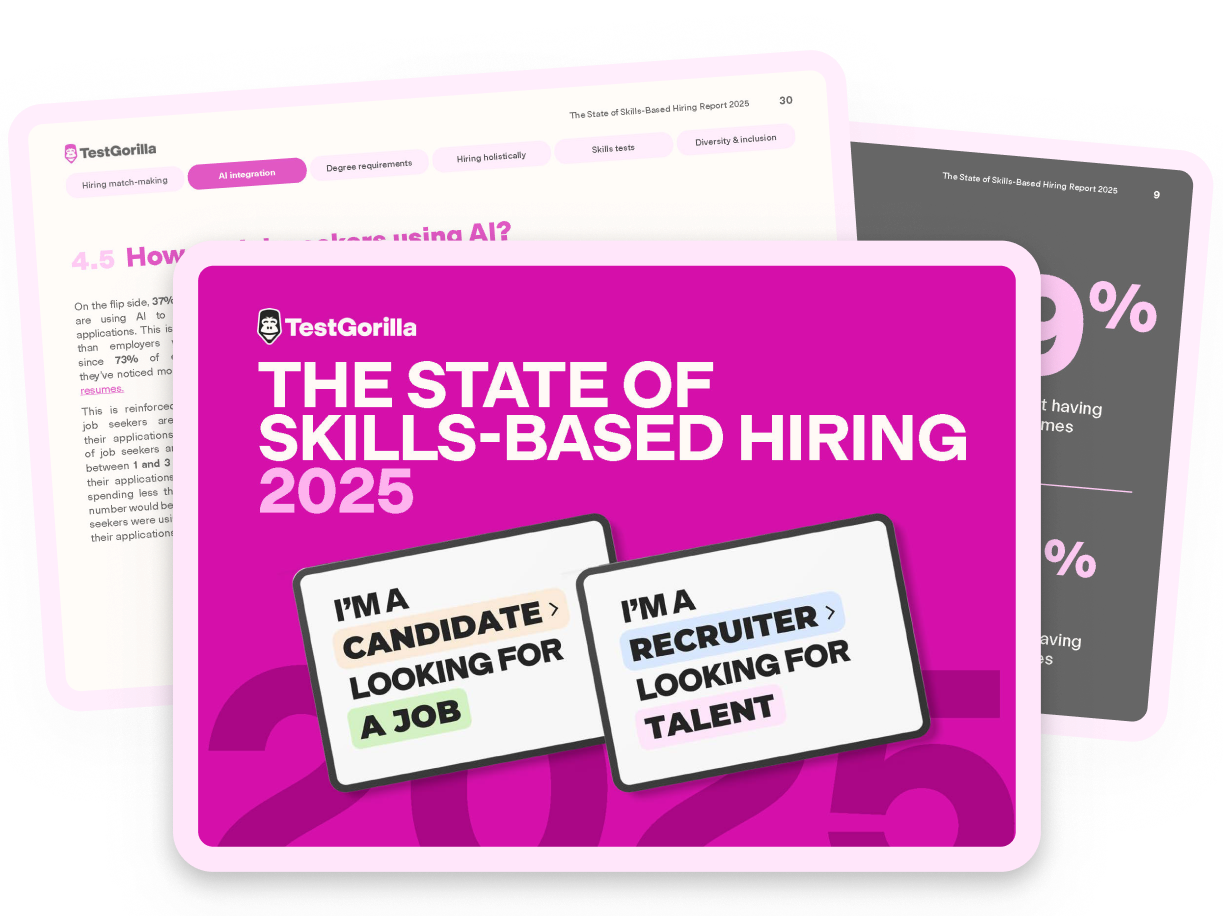
In the world's only annual report on skills-based hiring, we deep dive into the revolutionary recruitment trend to find out how employers are leveraging this approach, how it’s affecting candidate experience in the current job market, and how to do it best.
Are you a recruiter in tech or finance?
For data-driven insights about skills-based hiring in the tech and finance industries, check out our Tech and Finance reports. These resources are designed to help hiring managers in these industries implement skills-based hiring.
Skills-based hiring has impact
Skills-based hiring is high-impact for employers and candidates alike – check out these stats.
of employers reduce mis-hires
of employers improve retention
of 25-34 year olds prefer it
associate it with landing dream jobs
of Asian & Arab employees accessed new opportunities
of Black employees accessed new opportunities
of employers improved diversity
agree that skills-based hires stay longer

Should I switch to skills-based hiring?
Skills-based hiring practices can have a measurable impact on time-to-hire, cost-to-hire, retention, diversity, and number of mis-hires. But should you switch? Find out how our skills-based hiring platform creates these outcomes for companies around the world.
How do I get started?
We've got plenty of content to help you get started with skills-based hiring. Watch the video about why you should test for skills first, dip into the blogs below, or read our case studies to learn how other companies are doing skills-based hiring.
Implement skills-based hiring in 4 steps

What’s the first rule of hiring? Ask any organizational psychologist and they will tell you: “job analysis, job analysis, job analysis”.
Conducting a job analysis of the role you’re hiring for to identify your requirements is key to ensuring you're looking for job-relevant skills, and is the first step to implementing skills-based hiring. Read about how to conduct a job analysis.
What’s the first rule of hiring? Ask any organizational psychologist and they will tell you: “job analysis, job analysis, job analysis”.
Conducting a job analysis of the role you’re hiring for to identify your requirements is key to ensuring you're looking for job-relevant skills, and is the first step to implementing skills-based hiring. Read about how to conduct a job analysis.
Try skills-based hiring with TestGorilla
If you're looking for a pre-employment testing tool to use for skills-based hiring, try TestGorilla. We've got 400+ skills tests designed to help you hire top talent in a fair and data-driven way. Book a free consultation with our team or try for free today.